A fair, footnoted introduction

Jehovah’s Witnesses 101

From the book Why I Cannot Be a Jehovah’s Witness: But I Can Love My Jehovah’s Witness Neighbor, Book 2 of The Berean Series

Most of us know what Jehovah’s Witnesses do. Almost none of us can say what they believe. This book states their beliefs as a Witness would recognize them, from their own Bible, publications and website, puts their case at its strongest, and only then shows where it parts company with historic Christianity.

Coming soon in paperback and Kindle

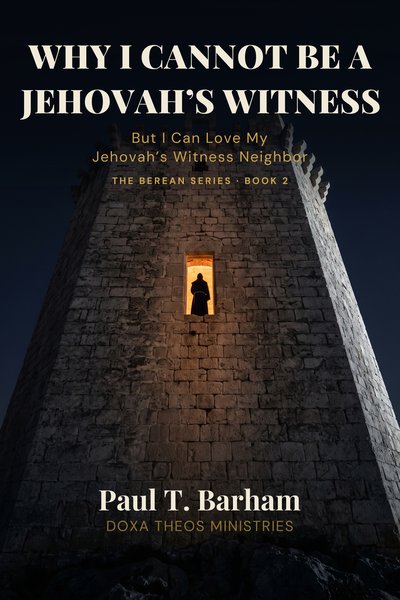
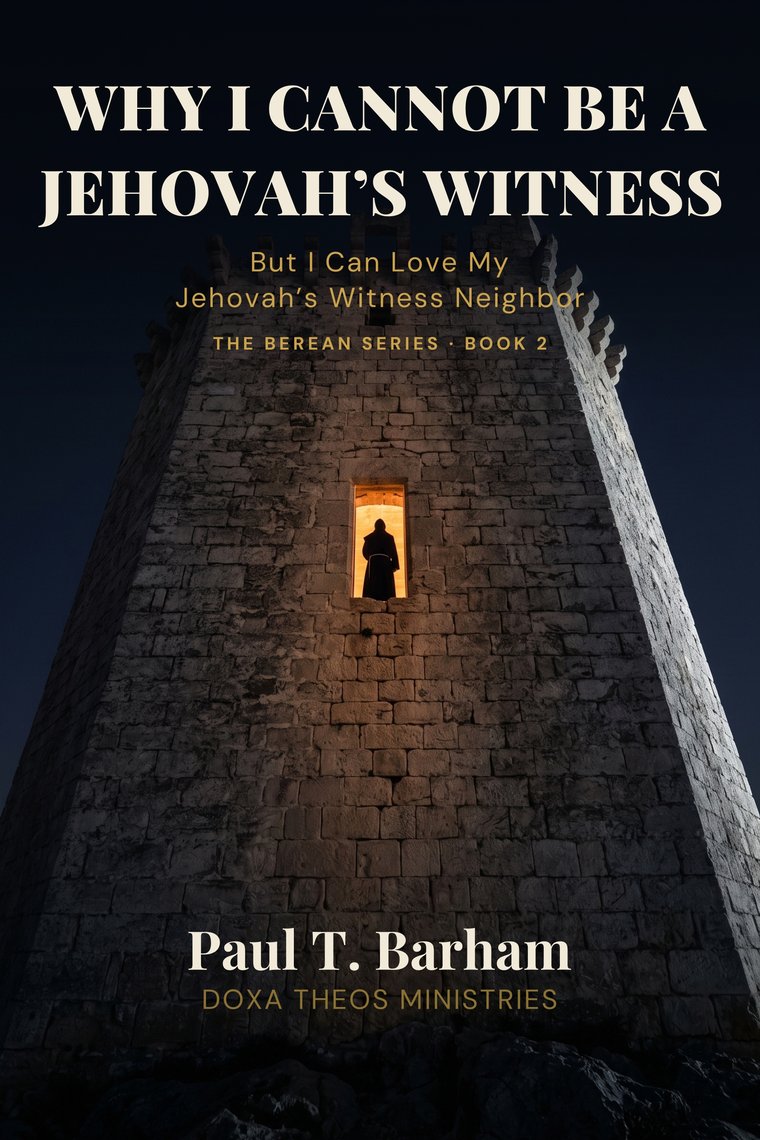
Why I Cannot Be a Jehovah’s Witness: But I Can Love My Jehovah’s Witness Neighbor, by Paul T. Barham
The heart of the book

Same words, different meanings

A Jehovah’s Witness and a mainstream Christian can agree on a sentence and still mean two very different things by it. These comparisons come straight from the book’s “TL;DR” appendix, which gathers every one of them in one place.

I believe the Bible is the word of God.Chapter 1
What a Christian meansThe Bible is God’s word, fully true, and given to the whole Church. Protestants stress that an ordinary believer with a good translation can understand what God asks of him; Catholics and Orthodox stress that Scripture is read with the Church and its long tradition. None of them teaches that right understanding arrived only in the late nineteenth century through a single publishing organization, or that the creeds confessed by all three are a departure from the Bible (2 Timothy 3:16–17).
What a Jehovah’s Witness meansThe Bible is God’s word, fully true and complete, but most translations have been clouded by church tradition, and the New World Translation has restored it, including God’s name. Its meaning is not for the individual reader to settle alone; understanding comes through the channel God has appointed.
Jesus existed before He came to earth.Chapter 5
What a Christian meansThe Son has always existed. There was no point at which He began and no moment when the Father was without Him. He was not made; the Word was with God in the beginning, and everything that was made was made through Him. Hebrews asks to which of the angels God ever said “You are My Son,” and the answer is none (John 1:1–3; Hebrews 1:5).
What a Jehovah’s Witness meansThe Son existed for an immense period before Bethlehem as Michael the archangel, the first and greatest of Jehovah’s creations, through whom all other things were then made. His existence had a beginning, and before it Jehovah was alone.
Jesus rose from the dead.Chapter 7
What a Christian meansThe body that was crucified and buried was raised to life on the third day, transformed and glorified but recognizably the same, with the wounds still visible. The tomb was empty because that body left it. Jesus remains fully human in heaven, and His risen body is the pattern for the bodies of all who belong to Him (Luke 24:39; 1 Corinthians 15:42–44; Philippians 3:21).
What a Jehovah’s Witness meansJehovah raised Jesus as a spirit creature. His fleshly body was not raised; God removed it from the tomb and disposed of it. For forty days Jesus appeared in temporary materialized bodies, as angels had done, and today He is a spirit person in heaven with no human body.
He fell asleep.Chapter 10
What a Christian meansA gentle word for death, spoken from the standpoint of those left behind and of the body laid in the ground. The person has not ceased to exist; he is with Christ, consciously, awaiting the resurrection, when he will be raised and made new. To be absent from the body is to be at home with the Lord (2 Corinthians 5:6–8).
What a Jehovah’s Witness meansAsleep in the sense of unconscious: no awareness, no dreaming, no passage of time, no person anywhere. What remains is Jehovah’s perfect memory of him, from which he will be brought back. Between death and that day there is not a lesser existence but no existence at all.
Salvation is a free gift.Chapter 14
What a Christian meansFree means that the verdict is God’s alone: the believer is justified now, adopted into God’s household and indwelt by the Spirit, and the works that follow are done from inside the household, not to gain entry. Christians differ on whether a believer can be certain of final salvation or can fall away, but they agree that he has been saved by grace through faith, and this is not of himself (Ephesians 2:8–9).
What a Jehovah’s Witness meansFree means unearnable: no one could ever deserve the ransom, and it was given through undeserved kindness. But the gift is received along a road that must be walked to the end: dedication and baptism, obedience, association with Jehovah’s organization and a share in the preaching work, with the outcome settled at the judgment rather than now.

The book has 25 of these comparisons, covering worship, the holy spirit, the resurrection, the Memorial, salvation, blood and more. See more →

Who it’s for

Written for three kinds of readers

Christians with Witness neighbors

Understand what the people at your door actually believe, so the next conversation is worth having instead of forty seconds on the porch.

Jehovah’s Witnesses with questions

See how the organization’s teaching compares with historic Christianity, stated fairly, sourced to its own publications, on your own schedule.

Pastors and small groups

A clear, sourced resource for teaching, with a glossary, a timeline of doctrinal change and a guide for anyone thinking of leaving.

This is not a book about whether Jehovah’s Witnesses are good people. Many are sincere, generous and disciplined, and some of their history is courageous. It is about whether the organization’s teaching is true. The word “cult” never appears in it.

Inside the book

26 chapters in six sections and a closing

Each chapter states what Witnesses believe in terms a Witness would recognize, sets it beside historic Christian teaching, and closes with a recap and footnoted sources. Scripture is quoted from the NASB 2020; the New World Translation is quoted where its own wording is the question.

I. The Question of Scripture

  1. What Jehovah’s Witnesses Teach About the Bible
  2. The Verses That Do the Work
  3. One Channel

II. The Question of Who God Is

  1. The Name They Took for Their Own
  2. The Archangel Who Became a Man
  3. Firstborn, or First Made?
  4. The Body That Left the Tomb
  5. A Force, Not a Person
  6. Why the Trinity Isn’t a Greek Invention

III. The Question of What Happens When You Die

  1. The Dead Know Nothing
  2. A Hell That Isn’t There

IV. The Question of Who Gets Saved

  1. The 144,000 and the Great Crowd
  2. The Bread That Passes By
  3. Counting the Hours
  4. Surviving the End

V. The Watchman’s Record

  1. How the Watchtower Was Built
  2. 1914: The Arithmetic Behind the Date
  3. 1925, 1975, and the Generation That Would Not Pass
  4. New Light
  5. A Test I Didn’t Invent

VI. The Cost of Belonging

  1. Blood
  2. Disfellowshipped
  3. Neutral
  4. Two Witnesses

Closing

  1. If You’re Starting to Wonder
  2. Where I Landed

Appendices

A guide for anyone leaving · the TL;DR of every “Same Words, Different Meanings” table · a glossary of Witness terms · a documented timeline of doctrinal change · recommendations for further study · a bibliography.

Get the book

Coming soon

Why I Cannot Be a Jehovah’s Witness

Why I Cannot Be a Jehovah’s Witness: But I Can Love My Jehovah’s Witness Neighbor · The Berean Series, Book 2
Paperback · 344 pages · 6 × 9 in · ISBN 979-8-9975230-4-6 · Kindle edition

Book 1 of the series is available now: Why I Cannot Be a Mormon, in paperback, Kindle, Apple Books, audiobook and Spanish.

Paul T. Barham
About the author

Paul T. Barham

Paul is a bi-vocational lay evangelist who preaches about once a month at a small chapel in North Carolina, and a software engineering executive with a B.S. and M.S. in Computer Science. Raised Southern Baptist, he now describes himself simply as a non-denominational, Bible-centered Christian. For years he sent Witnesses away from his door because he did not know enough to hold a conversation worth having. This book is what he found when he went and looked.

More books: paultbarham.com · Mormon 101 · Salvation 101

Stay in touch

Hear when the book releases

New books, release news and the occasional note from Paul. Unsubscribe any time.

This site is an independent Christian resource from Doxa Theos Ministries, written to accompany the book Why I Cannot Be a Jehovah’s Witness. It is not affiliated with, endorsed by or sponsored by Jehovah’s Witnesses, the Watch Tower Bible and Tract Society of Pennsylvania or any related entity. Names associated with Jehovah’s Witnesses, including JW.ORG, may be trademarks of their owners and are used here only to identify the subject of this commentary. Witness teaching is quoted briefly from the organization’s own publications for the purposes of criticism, comparison and scholarship.